




Drawing from the earth
Heringer Rauch, by Marina Hämmerle, April 2, 2025

Drawing from the earth
Anna Heringer and Martin Rauch
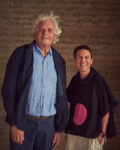
In conversation with Marina Hämmerle
Long version of the interview as part of the book project Architecture in Vorarlberg
Nowadays, cooperation is not only required in processes, but is also finding its way into modern building and timber construction technology. Local techniques and natural materials such as clay, straw, trass, lime, hemp and many more enable hybrid constructions that extend the range of qualities and possibilities of timber construction. In terms of a circular economy and a growing awareness of ecological building materials among clients, these construction methods are becoming increasingly important. Anna Heringer and Martin Rauch have been pursuing these approaches with innovative enthusiasm since graduating, bringing simple construction and participation back into play and drawing on remote ‘earthen’ cultures.
Not only do you both share the material clay and a love of architecture, but you also share an interest in other cultures and traditional production techniques.
Anna Heringer: That’s right. I moved to Bangladesh at the age of 19 because I wanted to see life from a different perspective. The result of this NGO work was the experience of a happy frugality. I learned there that the most effective strategy for sustainable development is to first identify the potential and resources in our environment and within ourselves.
Did you already have the ambition to become an architect back then?
AH: Yes, that was actually already on the cards. However, I was unsettled in this respect in Bangladesh because I experienced ‘real’ life there and was plagued by the fear that architecture would not be able to do it justice. I experienced both a strong creative impulse and a passion for development and social justice there. However, when I entered the University of Art in Linz, I felt I was in the right place. Roland Gnaiger and the Vorarlberg line were a conscious choice, ecology was very, very important to me.
Martin, you also planned houses for Africa during your studies – twenty years earlier. Was your brother Franz’s social commitment there your personal motivation?
Marin Rauch: I come from a large family of farmers and artists and have seven siblings. I visited my eldest brother Franz in Africa in the mid-1970s during my ceramics apprenticeship. My father and all my siblings share a penchant for creative self-empowerment, for socially acceptable design and living; it was through them that I came into direct contact with this field and clay building. In 1984, while studying ceramics at the University of Applied Arts in Vienna, I completed two semesters of architecture with Professor Willhelm Holzbauer. My participation in the international Low Cost Housing for Africa competition won me first prize – a great motivation to continue on this path. The project approach is convincing and is still valid – now, after forty years, we are working on its implementation, now the time seems ripe for it. Since then, I have repeatedly been involved in various construction projects in Africa, so I have developed a lifelong relationship with this continent.
What do you both have in common with Vorarlberg timber construction or with the building artists and architects working here in general?
MR: The social constellation and the region were essential for my development. Even my diploma thesis and my first self-employment were under the title Lehm Ton Erde – Werkstätte für Keramik und Lehmbau. In 1986 I came back to Schlins with my wife, to the environment of my extended family. The breeding ground here in Vorarlberg was ideal for me and I was close to the Vorarlberg building artists early on, at the end of the 1970s. For example, Rudolf Wäger designed my brother Franz’s house, which I also lived in for a while. Even back then, clay seemed to me to be a good, climate-regulating addition to these pioneering houses, and so it was used in the next house we built within the family: from 1982 to 1986, we used clay in various applications – planned and implemented together – in my brother Johannes’ house. Word spread among our friends and acquaintances, interest in earth began to germinate in the ecology-friendly Vorarlberg community and there was a great sense of optimism at the time. The citizens took responsibility and even formed a party of independents. A number of projects were created, for example with Wolfgang Juen, Hermann Kaufmann, Wolfgang Ritsch and others. At the first exhibition on Vorarlberg building artists in 1988 at Palais Thurn und Taxis, earth building became publicly visible for the first time and in 1989, winning the competition for the 150-metre-long rammed earth wall in the Feldkirch State Hospital catapulted the Lehm Ton Erde company into another dimension of application – a milestone for me and the topic.
And what distinguishes you, Anna, from the building artists and their successors? Does this include your premise of form follows love?
AH: I was attracted by the level of sustainability – optimized form and a pragmatic approach are fundamentally based on ecological orientation and a common sense of landscape and craftsmanship. What inspires me about Vorarlberg buildings is the sophisticated understanding of materials, the perfection in detail. Sometimes I miss the color or the femininity, I really miss that. Clay brings in this component, for me it is a feminine material. Many of our joint projects, such as the regenerative cave at Omicron or the birthplace at the Women’s Museum in Hittisau, we literally shaped by hand. In addition to this earthy feel, light, color and glass mosaics contributed to the sensually relaxing atmosphere. For me, wood represents the rhythm and clay the melody – it is the material that sets the tone.
MR: There is no doubt that the so-called Vorarlberg building school is very wood-oriented and technology-friendly. Wood is cut by machine, it requires precision in planning and execution, the art of line and joint, a certain rhythm. When timber construction is combined with clay, a craftsman’s scale comes into play and the scope for action expands.
The phenomenon of the Vorarlberg building school is based to a large extent on craftsmanship that is just as eager to develop. How do you experience the cooperation with the local craftsmen’s guild?
MR: For the pioneering architects, one of the premises was to plan cost-effectively; this often resulted in minimal construction and wall thicknesses, which would definitely undermine today’s standards. On the other hand, sophistication was evident in the details, proportions and compactness of the floor plans. This formative approach made local timber architecture famous throughout the Alps and beyond.
The phenomenon of the ‘Vorarlberg building school’ is based to a large extent on the equally innovative craftsmanship. The Werkraum Bregenzerwald association in particular is a showcase model in Europe. How do you experience the cooperation with the local craftsmen’s guild?
MR: In the early days, the architecture was very innovative – resource-conserving, material-saving, minimalist, promoting new living concepts. In my experience, the clients were often the driving force behind the use of clay and the architects had to come to terms with this. Later, the tide would turn as consumerism and digitalization made their way into society. The development of earth building stagnated for a long time, and even timber builders tended to view earth building with skepticism. Earth is dirt, makes the building site dirty and complicates the process. There was a great need for clarification; com:bau, the construction trade fair in Dornbirn, turned out to be a good platform for imparting knowledge about earth building and its qualities. Clay earth became a player for the passive house standard and scored points with cooperating craftsmen and builders in terms of comfort and climate-balancing effect due to its storage mass and capacity. Earth has what wood does not have, and vice versa; this synergy of balancing, complementary properties is beginning to be understood and politically supported in Vorarlberg.
AH: The courage, coupled with curiosity, that you find here in Vorarlberg and the appreciation of challenges in architecture seem unique to me. You almost feel like you’re in paradise when it comes to cooperation in planning and craftsmanship, because it takes place on an equal footing. If you compare this with Germany, for example, there are worlds apart. I am impressed by how responsibility is taken in the construction industry in this country, which requires special knowledge of materials and craftsmanship that is above average compared to other regions. What I would sometimes like to see is less fear of urban density.
This leads on to the leap in scale, which can be seen, for example, in the Hortus project in Basel, planned by Herzog & De Meuron: Hybrid constructions with wood are proving to be a new field of ecological building.
MR: The debate about sustainability and climate change is increasingly sparking interest in hybrid, nature-based construction technologies and promoting the current trend of reuse, recycle and repair. Although these findings were already widespread in the 1970s and 1980s, they were not taken seriously politically. Today, they are increasingly being addressed and solutions are being sought. It turns out that the combination of wood and clay is the absolute champion – wood as the best CO2 store and clay as a local resource. The wood provides the statics and the excavated clay acts as a temperature-equalizing storage mass, for example in load-bearing walls, in the ceiling construction or as infill in combination with wood chips, hemp or straw. The benefits of this CO2 balance make a huge difference. This is being recognized and we are seeing increasing interest from clients and planners in this construction method. Nevertheless, costs are still the biggest problem. The cost pressure is generally enormous at the moment, even for ecological buildings. This circular construction method should actually become cheaper, but the opposite is often the case.
For me, wood represents the rhythm and clay the melody – it is the material that sets the tone.
Anna Heringer
AH: The lack of cost transparency in construction – gray energy is often not priced in – is glaring. It shows: Our economic system is manipulative. Simple, circular and sustainable construction is not promoted accordingly. The disposal of one tonne of excavated material currently costs around 40 euros; this amounts to around 15,000 euros for a detached house. Builders are paying to get rid of this material, even though clay is the cheapest building material known to mankind. Apart from land prices, the cost driver in construction is the high taxation of labor and human energy; negative effects on nature and the environment, on the other hand, are not taxed. This is not a force of nature and could be changed tomorrow.
On the other hand, what about knowledge transfer? You work together with renowned architecture schools and studios that explicitly deal with circular, hybrid construction. Is there a need to catch up in education in this respect?
AH: The topic has actually arrived at the University of Liechtenstein, in several studios. Obviously the proximity to Schlins is having an effect. Via Roland Gnaiger, this building philosophy has spread as far as Linz, and research and work is also being carried out in this area at the ETH, where Hubert Klumpner and Guillaume Habert are pioneers and we have both been involved in planning and research projects since 2015.
MR: Nevertheless, there is still a lot of catching up to do, the supply is far from adequate. As long as earth building is not taught in every building trade school or technical college throughout Europe, you can forget about scaling up on a large scale because there are no skilled workers. This is why companies are reluctant to invest in earth building. The broad impact of contemporary earth building stands and falls with training. There have already been a number of discussions with representatives of the responsible ministry and the Chamber of Commerce; we are committed to ensuring that training as an earth building specialist, a management apprenticeship and at least earth building modules are offered at HTL level in the future. Negotiations on this are taking place at several levels, but not yet at state schools.
You will probably play a key role in this respect. Anna, your projects in Asia and Africa show impressively how the interplay of clay and wood can manifest itself in meaningful structures. What do you bring back from there and bring here?
AH: The process plays a major role in the projects in Southeast Asia. It seems fundamental to me that it is co-designed, as participation is a basic need. In India, it goes without saying that children and women are involved in building the school. Clay is inclusive. Clay does not require any heavy equipment or special tools, there is no risk of injury, and much is simply done with the hands. From time immemorial, children have spent time building things themselves; building is part of our human DNA. However, architecture in industrialized nations is becoming more and more digital and increasingly prefabricated. In our projects in Europe, we are therefore specifically creating areas in the planning that users – whether children or adults – can build. At the St. Michael campus in Traunstein, this included a seating landscape in clay, finished with Tadelakt, and clay reliefs in the timber construction. The experience in Worms Cathedral was particularly impressive, where everyone helped to stamp the altar. Building together, often using non-verbal communication, has an incredible power and creates a great sense of cohesion among those involved. We learn from countries in the global South: The process is just as important as what comes out at the end. Self-expression and self-efficacy are valuable aspects that are easy to implement in simple construction – as long as you give them space.
The Heringer Rauch working group already has many projects to its name. What can you do better as a duo?
AH: We can develop better together because we complement each other. We have found an instrument that merges our working methods.
MR: Anna and I start the design process differently, I begin at A and she at Z. I already experienced this cooperation, from different positions, as a student at Maria Biljan-Bilger’s sculpture symposia in St. Margarethen in Burgenland: Sculptors, painters, ceramicists and architects worked together. This interdisciplinary, collaborative work had a huge impact on me during my studies and was very much in line with my various inclinations. Back in Vorarlberg, I continued to practice exactly that – with the architects here in Vorarlberg, it was always a joint development on an equal footing. With Anna, it is even more pronounced …
AH:… and without words. We can’t talk about it well at first because we start with different approaches. As Martin already mentioned, for example, I have to feel the building first, get a sense of how it should be. I’m not interested in the entrance or the spatial organization, but in the right mood of the building. Nevertheless, I can be much more myself because Martin reacts calmly to my search. But if he makes a dissatisfied face, I know it’s not right. Martin has an unmistakable feeling for what works statically, what the material can achieve.
The combination of wood and clay is the absolute champion – wood as the best CO2 store and clay as a local resource.
Martin Rauch
MR: My starting point is feasibility. How can it be realized? I am guided by the material, the human scale, the emotional statics. Our method of claystorming, this value-free, open way of letting things happen, characterizes our collaboration. With this intuitively developed model, the three-dimensional sketching with clay, elements can simply be cut away or added. And the client understands immediately.
AH: You draw from the abundance and stay in the flow. You let yourself be guided by your intuition, your feeling …
MR:… and then it becomes finer and finer, more and more sophisticated. The clay allows for these nuances.
What was a highlight for you here in Austria where the Vorarlberg Building School left its mark?
AH: The birthing room in Hittisau was a wonderful collective process in which the two initiators and co-designers Anka Dürr and Sabrina Summer, the many women from the Bregenzerwald with their monetary project donations as well as Brigitta Soraperra and the Women’s Museum as the driving force and platform were so intensively involved.
MR: The object arose from the strong desire for an alternative maternity ward in Vorarlberg. Although it has a very feminine, unusual shape, it is a very simple building – reduced to three materials: wood as the foundation, clay as the body, shingles as the skin. An archaic form, built simply and inexpensively.
And where and why did you happily fail?
AH: A beautiful competition success with Nägele Waibel Architekten, a building school with exhibition rooms for Marrakech in Morocco, was unfortunately not built. But the good thing was that we used claystorming together with the architects for the first time on this project, and it really inspired us.
Your work has won numerous awards and continues to receive positive media coverage. The world’s most renowned museums, such as the MoMA in New York and the MAM in São Paulo or the Venice Biennale, are looking for your contributions. Anna, you are in great demand as a juror and both of you as speakers. Is there an award, an exhibition, a recognition that is particularly valuable to you?
MR: Honorary professor at UNESCO. The mission associated with this is to spread the word about earth building. This originated in France and is usually linked to a UNESCO chair, so it is otherwise only awarded to university institutions worldwide.
AH: Dominique Gauzin-Müller, Martin and I are the only three people to have received this award to date. There is no financial benefit from it. We are official ambassadors for earth building, so to speak.
MR: Many of the players who have made a difference in earth building today were previously in contact with us. You could almost think that we are the source of this flow.
AH: Stop, stop! You are my source. Although I read in my school magazine that Anna was going to build clay houses à la Hundertwasser, I thought that must have been a hippie fantasy during my studies, given the relevant trend in specialist magazines – until I met Martin at Roland Gnaiger’s BASEhabitat. The moment I had my hands in the material, I knew that was my path … In that sense, I’m only a second-degree source.