





Educating architecture and built environment
School, November 12, 2025

Educating architecture and built environment
When building culture comes up
Building culture affects us all, as it shapes the way we perceive and design our built environment. It influences not only the aesthetics and functionality of buildings, but also the social, cultural and ecological aspects of our lives. Building culture decisions influence how we perceive our surroundings and how our everyday lives are organized. For example, a well thought-out building culture can improve the quality of life by creating spaces that promote encounters and facilitate social interaction. Areas such as leisure, local amenities, health, living and working are crucial to how people move within the built environment and their community. Building culture therefore has broad relevance and concerns us all (Cf. Feller, Abendstein, in Fantastic Hypotheses, 2025).
Baukultur education plays an important role in promoting community engagement. There are initiatives and projects that do good work in this area. These include: Arkki School of Architecture in Finland, the bilding in Innsbruck, the VAI in Dornbirn, Archijeunes in Switzerland, Architektur Spielraum Kärnten and the Bink network. The latter has developed numerous modules that can be easily integrated into the curriculum with the “Baukultur-Kompass”. The aim is to learn how to see, express, name and describe. To sharpen the eye in order to be able to critically scrutinize the environment. Ultimately, the aim is to acquire the skills to play an active role in shaping the cultural landscape; essential teaching objectives for the subjects of technology and design as well as art and design.
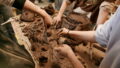
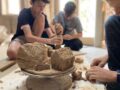
Children have an intuitive relationship with space. Education of built environment provides the necessary language to recognize, differentiate and ultimately help make decisions.
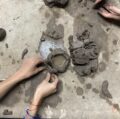
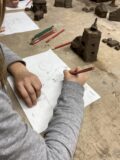
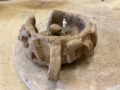
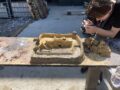
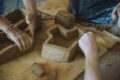
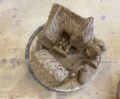
Erden Schule focuses on materials and creates opportunities to intuitively and haptically understand spaces through free clay work. This process is suitable for everyone. It requires no computer skills or design programs, no sharp tools, just your own hands, preferably a modelling tool, perhaps a fork and a butter knife. It is therefore also very immediate and very low-threshold in the work. It makes it possible to create an idea for a building or a landscape within a very short time. The nature of clay as a material makes it possible to let your own thoughts and ideas flow, or to quickly shape them or destroy them again. It allows you to pause, change and rework. At the same time, however, it is not “too” quick to generate countless variations. It is haptic and encompasses the whole body of the modeler. Flow moments arise easily. As the person communicates with the material through their hands, the design inevitably becomes a visual language.
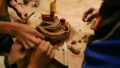
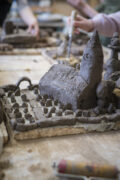
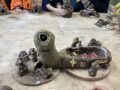
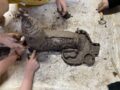
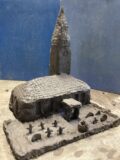
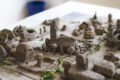
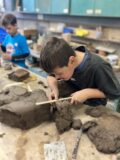
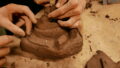
For us, communicating building culture means playfully exploring space and form.
Architecture, interior design and infrastructure have an impact and provide impetus for processes that take place. This is why space is also referred to as the third educator in pedagogical concepts. We sense this potential in our work with pupils. When they enter the Erden Schule studio, they are met with many new sensory impressions. The first arrival in the workshop is usually accompanied by a sigh of relief on the part of the students and often also the teachers. There is time and leisure to get involved in something new.
Both in the free clay work and in the building culture mediation, we value openness to results, expression and knowledge. Playful creation is as important as the final results. For the adults involved, this often means taking a step back and not shortening the path of knowledge through their own experience. We see appreciative, observant and calm guidance in an inspiring environment, with time and mental freedom, as a basic prerequisite for creativity-promoting aesthetic and playful work. Ultimately an enrichment for the individual and the community.
Those who play and forget limitations create something new.