







New machines and tools
in rammed earth construction
Lehm Ton Erde, by Martin Rauch, March 26, 2025

New machines and tools
in rammed earth construction
LEHM 2024 – An impulse from Martin Rauch
Development
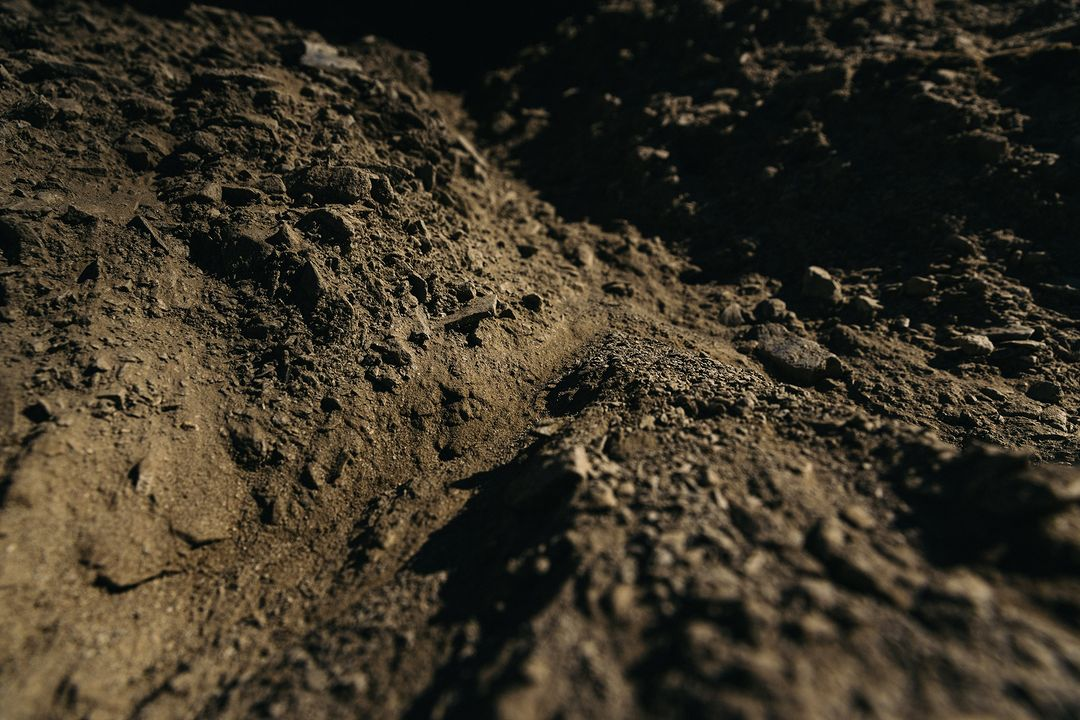
Rammed earth construction is based on a very old technique that does not require any stabilization – then as now.
Mineral earth as a building material has enormous potential – from artisanal, labor-intensive methods to high-tech, mechanical approaches. Nevertheless, this construction method has largely disappeared from collective architecture. Two reasons are particularly decisive: the industrial revolution made mass materials cheaper and more easily accessible, and at the same time building with earth was stigmatized as regressive or even as a symbol of poverty.
In rammed earth construction, earth-moist, crumbly material is placed in layers in a formwork and compacted. This compaction – using hand rammers or modern vibrating machines – transforms the loose earth into a load-bearing mass. The quality of the final result does not depend on whether compaction is carried out manually or mechanically.
We use our projects to document the material properties that make rammed earth so valuable and how we use innovations in prefabrication to make rammed earth components more efficient and usable for larger construction projects.
Many of our innovative construction projects would not have been possible without accompanying research and the development of special tools and machines. This has shown that Martin Rauch often invests just as much time in the construction and adaptation of machines as in the work on the building material itself.
Our aim is not to modify the rammed earth with cement or other chemical additives. Instead, we develop tools and machines that facilitate the construction process, make it economically viable and make work more efficient for everyone involved. Because the development of tools has always been a decisive factor in making hard work easier.
Preparation
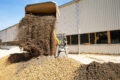
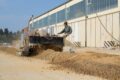
A key advantage of rammed earth technology is that the local excavated material from the construction site can largely be used directly. From our many years of experience, we can say that, as a rule, 50% to 100% of the excavated material can be used for various types of earth construction.
In Austria, for example, around 65% of construction waste is excavated material, most of which has to be disposed of and landfilled. These materials are often transported over long distances, which has a significant impact on the carbon footprint of construction sites.
Processing is easiest if the freshly excavated material is immediately passed through suitable screening plants in dry weather. This allows the loamy, stony components in the 0-32 mm range to be separated. Coarser stones are ideally crushed in an impact mill to grain sizes of 0-22 mm, 22-32 mm and 32-70 mm.
One to three sample mixtures are created based on the minerals they contain and any other readily available materials. These are first test tamped, which gives experienced experts an immediate first impression of the quality. After checking the compressive strength, the best mixture for the construction project is selected.
Storing and mixing the individual components according to the recipe requires a lot of space, which is often not available on tight construction sites. It therefore makes sense in future for local recycling companies to include crumbly rammed earth material from excavated soil in their product range. Earth construction companies could use this directly, which would save landfill sites and reduce the cost of the material in the long term.
Existing gravel processing plants around the world can be used to process the excavated material. Special earth processing plants are not necessary.
For mixing on site, the earth components are piled up on a paved area with a wheel loader according to the recipe and thoroughly mixed. For decades, we have also been using a self-built, mobile reversible mixer, which we call the “Wendelin”: A rotating mixing shaft travels on caterpillar tracks through the piled soil, with water being sprayed in as required to set the optimum moisture level.
Converted concrete mixers are also ideal for producing large quantities of rammed earth. Another advantage of unstabilized rammed earth is that it can be premixed in large quantities and stored indefinitely protected from moisture. The quality of the mixture is further improved during storage by so-called “mashing”.
Logistics
Transporting the earth-moist rammed earth mixture into the formwork is a central component in order to achieve the best solution economically. Choosing the right conveying system is a challenge for every construction site, as the balance between manual labor and machine use must always be found individually. Depending on labor costs and the size of the construction site, this can have a significant impact on the overall costs.
Rammed earth is heavy and cannot be pumped. The earth-moist, crumbly material can therefore only be moved with a few conveying systems available on the market. Additional conversion measures are often necessary to get the material into the formwork quickly and easily. From an economic point of view, this is a decisive factor. At the same time, there is still a need for research to further optimize the processes.
Formwork systems
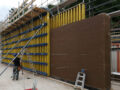

The core of a historic rammed earth formwork consists of two parallel boards and an end board, which are fixed in the wall thickness by tension elements. The moist rammed earth mixture is placed in layers between them and compacted with hand rammers.
The choice and targeted use of suitable formwork is crucial – both for the economic and qualitative implementation of a rammed earth construction site. In rammed earth construction, the formwork generally has to be more stable than in conventional concrete construction, as this is the only way to optimize the compaction of the material.
The horizontal layer-by-layer compaction process requires the lowest possible number of anchors in the working area and the formwork system is adapted depending on the wall thickness.
Compaction process
The crumbly, earth-moist rammed earth mixture is dynamically introduced into the formwork depending on the situation: by beating, tamping, vibrating, rolling or pressing – individually, one after the other or in combination. In principle, the same compaction result can be achieved with a manual tamper or fully automatic technology.
This versatility is what makes rammed earth construction so fascinating: the technology is equally suitable for low-tech and high-tech solutions. However, manual tamping is very strenuous and time-consuming. This is why pneumatic or electric hand rammers have been developed over the years to make the work much more efficient.
Originally, these rammers were not intended for earth construction, but for molding sand using the metal casting process. With the switch to other pressing methods, the production of such hand rammers was greatly reduced or discontinued. Due to the renaissance of rammed earth construction – also worldwide with cement-stabilized projects – various pneumatic hand rammers of different sizes are now available again from several manufacturers.
There are damped and undamped rammers on the market. Older, tried and tested models are usually very powerful, but are not damped and generate high vibration levels.
In order to be able to continue realizing large rammed earth projects efficiently, we are developing machines that pick up the rammers and compact them independently layer by layer within the formwork. We have already successfully implemented a similar system in our stationary prefabrication plant.
To minimize manual work, we generally use electrically operated vibratory plates; very narrow but heavy vibratory rollers are used for large formwork.

Prefabrication
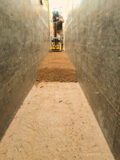
We have been operating the world’s first prefabrication plant for rammed earth elements since 2012. We have now installed these plants at four locations as so-called “field factories”. We affectionately call the first plant Roberta I, and now there is also Roberta II, which is currently being leased to a construction group for twenty months for a major project in France, including the transfer of expertise.
The core of the system is a 40 to 70 meter long formwork, along which the complex machine can be moved on rails. The central component is the feeder, which picks up the rammed earth material and feeds it into the formwork in layers via a cross conveyor belt and removes it at height. Directly behind this, vibrating plates ensure that the earth layer is pre-compacted. Subsequently, very powerful, undamped pneumatic hand rammers on a swiveling support take over the final compaction.
This complex mobile machine takes on the hardest and most strenuous work in rammed earth construction in a single operation – the equivalent of four employees working at the same time, without any legally prescribed usage restrictions. This enables us to produce earth elements in a time-saving, energy-saving and qualitatively consistent manner.
The system has a modular design: Different tools can be attached to the feeder and core system. This allows us to produce earth elements with wall thicknesses from 6 to 85 cm. After stripping the formwork on one side, a cutting machine is installed, which divides the wall into segments that are successively lifted out of the formwork and stacked for drying.
A field factory of this type requires sufficient space, ideally in a hall or under a temporary roof, and is economically viable for projects of over 2,000m² of earth wall area.
The further development of the field factory is the so-called field machine – a completely new approach. The aim is a mobile, compact machine that can be set up quickly, which is filled with tamping material at the front and simultaneously performs shuttering, compaction and cutting at the core. Finished rammed earth blocks are output at the rear. This means that the technology can be brought directly to the construction site instead of transporting material. This solution is particularly interesting for smaller projects.
Pneumatic rammers are energy-intensive and inefficient. That is why we have developed a powerful electric rammer for Roberta II, which requires only a fifth of the energy and is significantly more powerful. Due to its greater weight, it is either mounted on a machine or guided along the formwork on a mobile trolley. After initial tests, this electric rammer has proven itself in practice.
Perspectives
The potential of machine development in rammed earth construction is far from exhausted. In view of the fact that 1m³ of concrete releases around 25 times more CO₂ than rammed earth, the importance of technological developments for climate protection becomes clear.
Upscaling in earth building is only possible through continuous technological development, accompanying research, training and the growing interest of the construction industry. Transparent cost transparency for building systems and political framework conditions, for example in the form of a CO₂ tax, could supplement the lack of lobbying.
It is encouraging that many international research projects are currently active in earth building – a good sign for further innovations. Above all, these developments help to increase confidence in unstabilized earth construction methods and turn rammed earth construction from a niche solution into a self-evident construction method.